

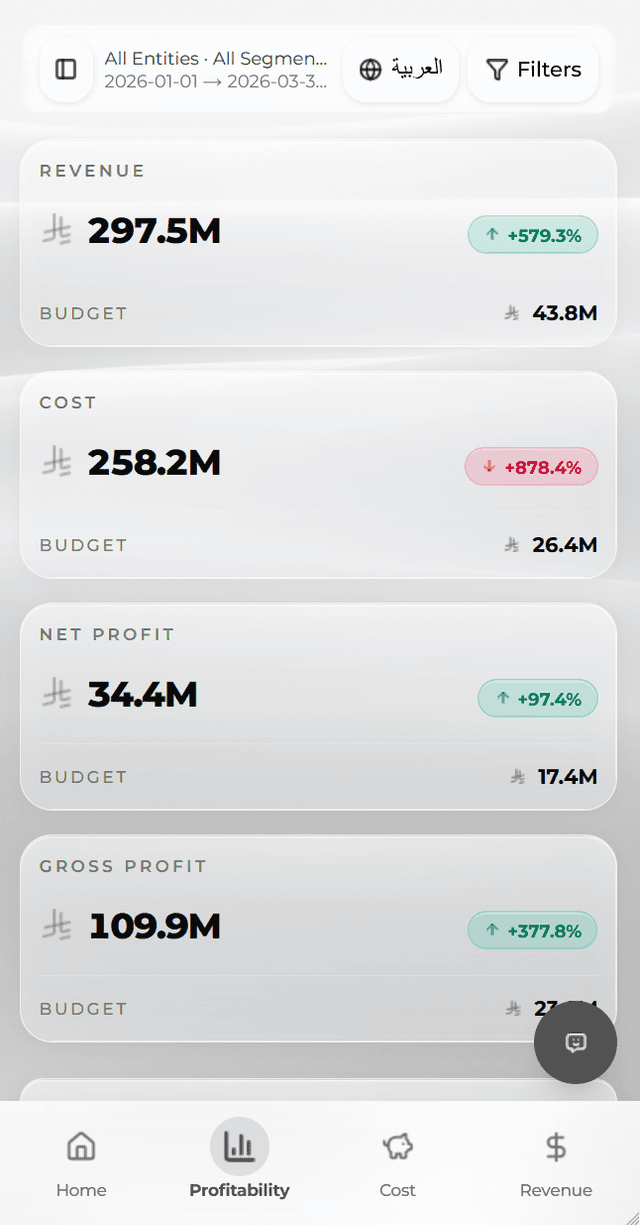
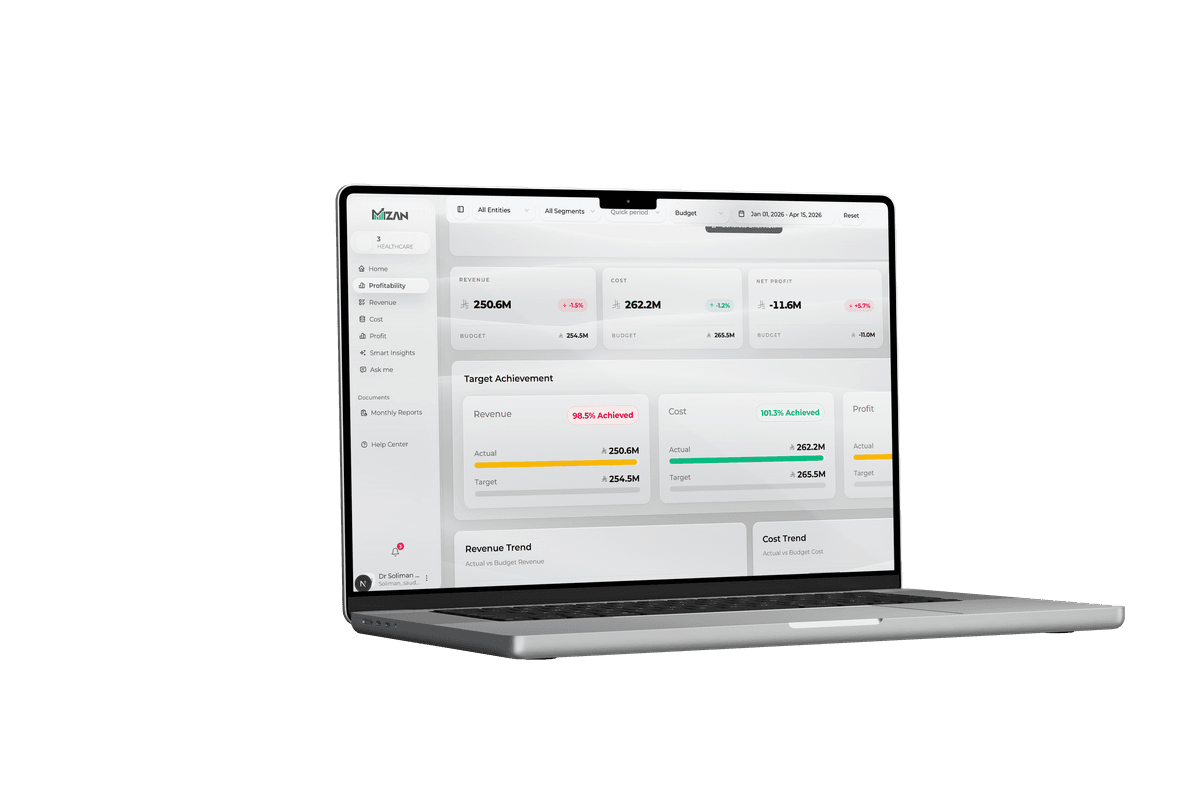
MIZAN by NEXEL is a financial intelligence and multidimensional profitability analysis platform for CFOs, finance teams, and business leaders. It combines financial and operational data with governed financial definitions and allocation rules to analyze revenue, direct costs, indirect costs, allocated costs, contribution, margins, budgets, variances, and profitability across configured dimensions, including companies, legal entities, business units, branches, customers, products, projects, contracts, departments, service lines, routes, and other organization-specific structures.
- ▹Multidimensional profitability analysis: Examine revenue, costs, contribution, margin, and profitability across the dimensions configured for the operating model, such as company, entity, business unit, branch, customer, product, project, contract, department, service line, route, facility, profit centre, cost centre, or program.
- ▹Governed financial model and allocation: Combine financial and operational data with approved definitions, hierarchies, drivers, and allocation rules. Refresh timing depends on the connected source systems and deployment design.
- ▹Governed AI assistance: Use plain-language questions and generated explanations to support analysis while finance owners retain review and decision responsibility.
Finance teams often have revenue, cost, budget, and operational data spread across ERP systems, business applications, and manually assembled reports. That fragmentation makes it difficult to explain margin changes or compare profitability consistently across products, customers, projects, branches, routes, and service lines.
Is MIZAN the right profitability analysis tool for your organization?
MIZAN is an implemented application that is configured around each organization's data, profitability definitions, users, and decision needs. The agreed scope determines integrations, refresh cadence, measures, dimensions, and access controls.
Good fit when
- CFO, FP&A, finance, and business teams need a shared profitability view rather than separate spreadsheet interpretations.
- Decisions depend on product, customer, project, branch, route, department, or service-line profitability.
- Management needs repeatable margin, cost-to-serve, and budget variance analysis from governed definitions.
Implementation requires
- Accessible financial and operational source data for the agreed analysis scope.
- Approved definitions for revenue, cost, margin, allocations, budgets, and organizational hierarchies.
- Named finance and business owners who can validate mappings, calculations, access, and outputs.
Limits and non-fit
- MIZAN does not replace the ERP, accounting ledger, statutory reporting process, or accountable finance judgment.
- Analysis quality depends on source quality, completeness, mapping, allocation rules, and refresh cadence.
- AI-assisted explanations require human review and should not be treated as autonomous financial decisions.
- Organizations without reliable source data or agreed profitability definitions should complete that foundation first.
MIZAN Modules
Profitability Analysis
Compare revenue, direct cost, indirect cost, allocated cost, contribution, margin, and profitability across the business dimensions configured for the deployment.
Margin & Cost-to-Serve Analysis
Investigate where volume, pricing, service mix, fulfilment cost, discounts, or allocation choices are changing contribution margin and cost-to-serve.
Budget Variance Analysis
Review actual performance against approved budgets and targets by the organizational and financial dimensions available in the connected data.
Management Reporting
Prepare repeatable performance views and management commentary from a governed financial model, with finance review before distribution or decision use.
AI-Assisted Questions
Ask plain-language questions about the connected profitability model and receive structured analytical responses. Results depend on source data, mappings, permissions, and configured calculation rules.
Governed Access
Organize financial analysis around defined users, roles, measures, and source mappings. Deployment controls and hosting arrangements are confirmed during solution scoping.
Ready to examine profitability with MIZAN?
Bring one priority profitability question to a working session with NEXEL and define the data, dimensions, and decision scope needed to answer it.